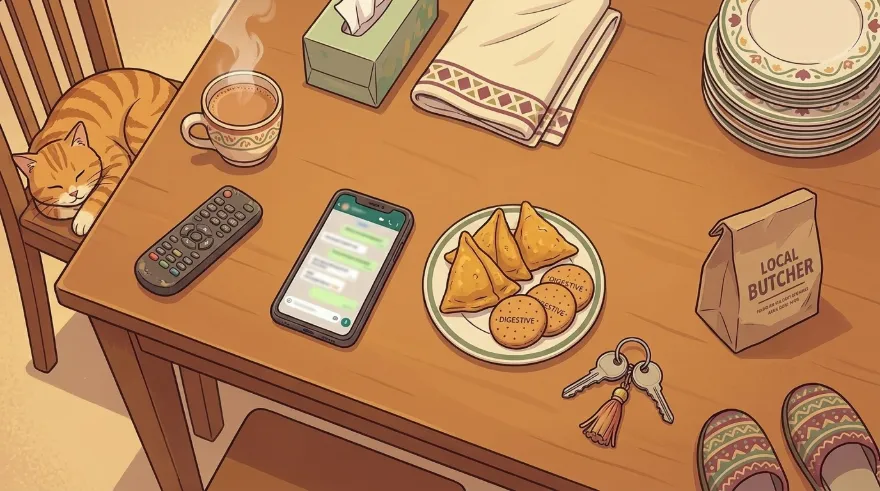
Whose turn is it for chai? Why is there a guest at the door? The tiny domestic dramas every Desi household will recognise instantly.
Some stories begin with a huge event. At House No. 786, they usually begin with someone shouting from another room.
That is where the show lives: in the tiny everyday moments that somehow become full family emergencies.
House No. 786 is inspired by the kind of domestic chaos many British Desi households know immediately. Not dramatic in the outside-world sense. Dramatic in the family sense. The kind of drama where nobody is in real danger, but everyone is acting like the reputation of the house depends on finding the good plates in the next thirty seconds. These are the small moments that inspired the world of No. 786.
This might be the most powerful sentence in the house. The moment Sadia says "guests are coming," the whole family enters emergency mode. Cushions are straightened. Shoes are hidden. The front room is suddenly inspected like a hotel lobby. Someone is told to change. Someone is sent to buy something. Someone is accused of making the house look like "nobody lives here properly."
The funniest part is that the guests might not even be formal guests. It could be one auntie popping in for ten minutes. Still, the house must transform. To outsiders, it looks like cleaning. To the Alis, it is survival.
In some houses, the TV remote is a device. At No. 786, it is a symbol of power. When the remote goes missing, the investigation begins immediately. Everyone is questioned. Nobody admits anything. Someone says they "just had it." Someone else says they never touched it. Rayyan somehow knows where it is but waits too long to reveal that information.
Imran treats the missing remote like a test of family discipline. Ayaan says he is helping, but mostly lifts one cushion and gives up. Aaliyah asks why one plastic rectangle controls the emotional temperature of the house. Biscuit sits near it, quietly guilty and completely unbothered.
Chai is never just chai. It is timing, mood, hospitality, family duty and emotional repair in one cup. At No. 786, the question "Who's making chai?" can expose the entire household. Someone suddenly has homework. Someone is "busy." Someone says they made it last time. Someone argues that boiling the kettle counts as contribution.
Chai is what appears when guests arrive, when conversations get serious, when someone is upset, when someone is pretending not to be upset, or when the family has no idea what else to do. It is comfort. It is routine. It is also a chore everyone tries to dodge.
Every Desi household knows the danger of forgetting the meat in the freezer. It starts quietly. Sadia asks one simple question: "Did you take the meat out?" Silence. Then the whole room changes.
Suddenly people are remembering instructions differently. Ayaan says he thought Rayyan was doing it. Rayyan says he was literally about to. Aaliyah asks why the family has no written system for meat responsibility. Imran says this is what happens when nobody listens. What should be a small mistake becomes a full investigation with suspects, motives and evidence. Dinner is not just delayed. Trust has been damaged.
For Imran, a light left on is not just a light left on. It is a financial event. A moral issue. A sign of everything wrong with the younger generation. The phrase "Why is every light in this house on?" can be heard across No. 786 even when only one light is actually on. It does not matter. The principle is bigger than the bulb.
Someone will say they were coming back. Someone will say it was only for two minutes. Imran will explain that two minutes becomes four minutes, four minutes becomes a bill, and the bill becomes a lesson nobody asked for.
A knock at the door has different meanings depending on who hears it first. If Sadia hears it, the house becomes alert. If Imran hears it, he checks who it is and why they are here. If Rayyan hears it, he becomes invisible. If Ayaan hears it, he decides whether he looks presentable enough to be seen as a responsible adult. If Aaliyah hears it, she asks who invited them and why nobody was informed.
The front door is where the outside world enters the family system. That is why nobody opens it casually.
A trip to Barakah Bargains on Chai Street should be simple. It rarely is. Someone is sent for milk and comes back with snacks. Someone forgets the one thing they were sent for. Someone buys the wrong brand. Someone says the price has gone up and turns it into a speech about the economy.
The corner shop run is funny because it feels like independence until the phone starts ringing. "Where are you?" "Did you get the bread?" "Not that bread." "Send me a picture." By the time the errand is finished, it has become a group project.
Every family has an errand that separates confidence from competence. For Ayaan, it is the halal butcher. He wants to be taken seriously. He wants to be useful. He wants to prove he is grown. Then the butcher asks: "Breast or leg? How many kilos? Boneless? With skin?" Suddenly, adulthood becomes very specific.
The halal butcher run inspired House No. 786 because it captures a perfect kind of family comedy: being technically old enough to do something, but emotionally unprepared for the follow-up questions.
The family WhatsApp is where information, panic, reminders, duas, blurry photos, voice notes and suspicious forwarded messages all live together. At No. 786, the group chat can create drama without anyone entering the room. Someone leaves a message on read. Someone sends a screenshot to the wrong person. Someone replies with "OK" and everyone knows they are not OK.
Rayyan understands the technology. Imran distrusts it but still uses it. Sadia uses it like a command centre. Aaliyah asks why everything needs to be a voice note. Ayaan tries to sound mature and fails with one typo. The family WhatsApp is not just communication. It is evidence.
In House No. 786, some arguments are not really about the thing being argued about. They are about people. Who are the people? Where are they? Why do they care? Nobody knows exactly, but their opinion is powerful.
This is where Aaliyah shines, because she is always ready to ask the question everyone avoids: is this actually important, or are we just scared of invisible community feedback? The joke is not that families care about reputation. The joke is that sometimes "people" become a mysterious committee nobody has ever met but everyone is trying to impress.
Around Masjid-e-Barakah, the comedy comes from the human side of community life. Leaving on time becomes urgent. Parking becomes strategy. Shoes become a memory test. A quick conversation after prayer somehow becomes much longer than planned.
The masjid itself is treated with respect. The humour is in the everyday situations around it: familiar faces, uncle advice, auntie updates, charity reminders, Eid crowds, and the impossible challenge of leaving without being stopped for "just two minutes." It is part of the rhythm of the neighbourhood. Faith, family and community all moving through ordinary life.
This phrase deserves its own place in the House No. 786 universe. "I was literally about to." It can mean many things. I forgot. I remembered when you said it. I was not going to do it. I hoped someone else would do it. I am now emotionally prepared to pretend I was already moving.
Rayyan says it with confidence. Ayaan says it with stress. Everyone has used it at least once. It is the official language of delayed responsibility.
The everyday moments that inspired House No. 786 are small on purpose.
Because real family comedy is not always about huge plots. Sometimes it is about the way someone says your full name from downstairs. The way the house reacts when guests are coming. The way everyone denies touching the remote. The way one missing item can reveal everyone's personality.
These moments work because they are familiar. They are warm. They are slightly ridiculous. And they carry the feeling of home. House No. 786 takes those tiny household dramas and turns them into short animated stories: fast, funny, character-led moments from a family that feels like it could live on your street.
Because sometimes the smallest thing in the house becomes the biggest story of the day.